

BOOKENDS '25
stories about songs I liked from this year

“Amber Waves”
Is it not fun to feel many other ways?1
Before we knew about any fire, mama and I worried that the Santa Anas would rip off our own roofs. I was sleeping in the ADU next to mama’s cottage on a XL twin-sized bed beside the washer and dryer and a shrine she had made of citrine, bundled sage, and a moss-scented candle. I prayed the Ojai rosary; I popped an indica Camino. The wind blew so forcefully I could feel the pressure resonate through the bedside window and onto my shivering, scarred face. It was the new year. My hair was long and unkept toward an unresolvable greasiness. Photographs of me returned portraits of a girl who didn’t know how to groom herself, and the right songs let me inhabit that vision. The clock blinked “00:03,” four digits to say I could stream the new Ethel Cain album.
I was getting closer to the stone of it all. The world creaked hard as if it was a poorly fabricated chair ready to come apart. I could hear the girl singing to me now. Droning drowned the dark room. Fear really presented itself to me—too alone under the thin corrugated metal roof, too permeable in my high, too responsive to the slightest pickup and quiver. Then muted plods of steel guitar sedated my nerves. I grew calm, caught up in the story: a catatonic narrator sizing the risk of her addiction against the potential of true love, Amber, who waves from a field of distance, dejection.
(I don’t know how to groom myself, but I know where the chainlink unravels to a hole big enough to crawl through. On one side there is a home and on the other is something I haven’t felt yet—in between these states is a harsh scrape.)
The wind wouldn’t let up, beating around me until I got too overwhelmed by the awareness that I am in fact always utterly crushable. I thought I had grown up, but decided to retreat when the weather came down to it. Got into mama’s bed. Fell asleep. When we woke up, it was like a reenactment of childhood. And then we braced ourselves for the drive to the airport down the 101 that extended southbound into a rising wave of smoke, backlit by flames and hued in amber.
“Girl Feels Good”
When a girl feels good, it makes the world go ‘round...2
Like an inverse Liz Phair splashed in sleazy city art pop, FKA twigs fucked so we could run. Watery synths launch into a strut, low tempered bass bubbling just below the frenetic crash of high hats—it’s Eusexua in the City. I felt the city first in my femurs and the ligaments around it. Midtown walking to downtown life, going miles in temperatures I hadn’t before endured. Sub 30. Sub 20. Single digits. I layered sleeves and pant legs until my joints became inarticulate. But it was all novelty and news to me: the sirens screaming jackhammer car alarms buzzers tossing language into the space between a(utono/nony)mous bodies. Sparked by endless possible objects of desire, I figured I was in love again. On Valentine’s day I interviewed for a job at a restaurant and spent the rest of the day drinking rare reds with the providers of my good fortune in the city. All dichotomies were lost on me—the revel was in the surreality of my circumstance. The tug-n-pull of cause-n-effect made me think of the pumpjacks I used to pass on the Ventura highway: an extractive device engineered with determination to exhaust a valuable resource. But instead of tapping an oil well I tapped other high-cost substances. Anything to make the body what it really wants to be: good feeling. Spit or line or glass or whathaveyou—it was all delicious, and, for once in my little townie life, within snatching distance. So I snatched at the sense of a good score. When the girl feels good, she cages her disconcertion. Tundras nihil refert. Love, the sucking up of it, comes richly before depletion. It makes the world go ‘round.
“Full On”
I saw every quarterback crying…3
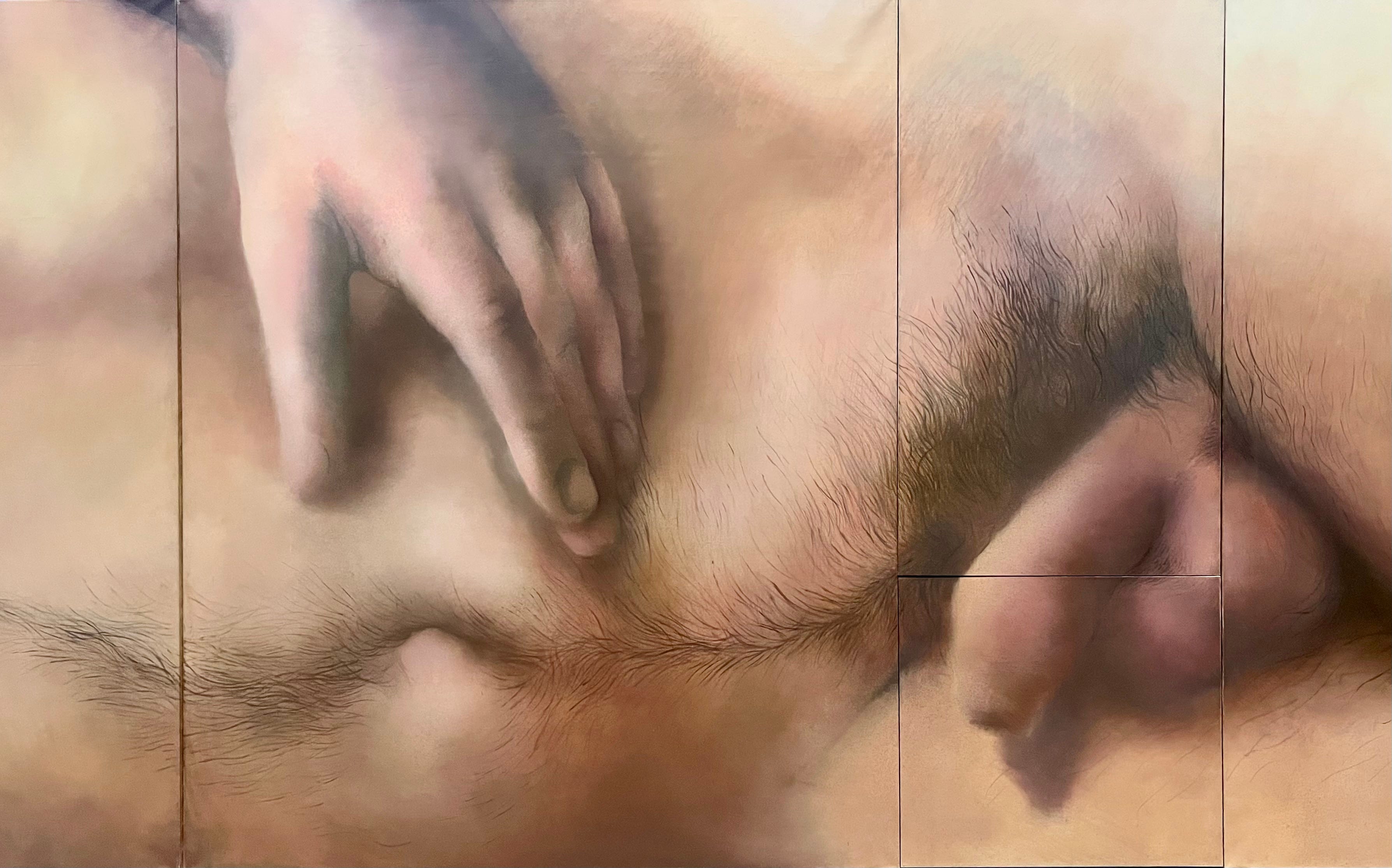
West Hollywood, Winter, 1976. The American actor Sal Mineo had just pulled into the carport below his apartment when a pizza delivery man stabbed him in the heart. He died there, alone, prostrated under his own home. A decade earlier he laid naked before the American painter Harold Stevenson, who used Mineo as a model for his masterpiece The New Adam. The painting, which sprawls across nine linen panels measuring at 40-feet in length, pays tribute to Stevenson’s lover, Lord Timothy Willoughby, and torques the canonical depiction of Adam with his finger pointing toward his naval rather than the reach of God. The palette of Adam/Willoughby/Mineo’s skin is peaty and burnish, texturized by clusters of body hair, reminiscent of sagebrush spotting a desert hill.
When I first saw the painting, I obviously first thought of that actor whose death I’d read about years ago, then of my own lover, then of the desert. What bodies, their beauty in its barest state, untamed toward a secluded tenderness we’ll do anything to protect.
Three bodies in one: the lover (the immortalized), the actor (the mortal), and the land according to the artist (the creation of God). Three bodies overlaid in a crossfade between their perceived virility and their private vulnerability. Examining the crossfade of manhood from virility to vulnerability and back again is the lyrical and logical point of Perfume Genius’s music, which is why I am devoted to it. PG frontman Mike Hadreas can make sops out of dry-land soldiers—or, in the case of “Full On,” crybabies of quarterbacks. I saw him go / Straight to the ground / I’m running full on / To lay my hand on his back. Hadreas, like Stevenson, portrays the sensuous juxtaposition of men in soft repose with the boldness of Gigantism, each strum of his zither-ish guitar reverberating like a ginormous bell—a toll for the funeral procession, for the end of football season, for the hour before sleep when we finally get to tuck our limbs and hands into the protection of a lover’s approach.
“Bookends”
I’m still wondering where Riley went…4
First I lost my man, and then I lost my mind. First I lost Riley, the musician. He let himself go. I wrote about him leaving, but only once he was surely wordless. I gave him more life in this way. I gave him my mind in quantities I could not offer when we were together. And in giving him my mind and more life I let that of myself go, in phrased doses. I gave my life away in this way. I give myself away right here, bloodletting by the sentence. I am expelling life, I am giving more of it. But you don’t care about these sentences unless they mean something to you, and how am I to guarantee that at all? You would care if you had loved Riley. If you had lived through his letting himself go away from you. Yes, this would only mean something to you if had something to lose. If you lost your man you would lose yourself in trying to give him back more life. I have lost Riley among other men. A haystack of bones could not illustrate the loss. Only the garble of a eulogizing harmonica, the croon of a soul singer, the limits of sound reachable only when played out from the mania of loss. Only the limit of sounds could bring him back, Riley, the Crossbreaker. Limits exist to be met and lost to. And so he let himself go away from me. And so I am left losing myself in phrased doses trying to figure out where he went, and trying to get you to care. You will listen to a story only if it resonates with you, not if it leaves you more uncertain about what you have left to give and lose. You will read this only if I have something to give you—and if I do, it’s already too late for you to know.
Postscript (for E.)
I. “Carousel”
You find solace in the horror…5
You met me at a very infinite time in my life. You met me in a time in which I decided writing is everything, so of course you were selling me a book. When we first met, in this very infinite time. There was a table’s worth of space between us; the table was covered in books. We met a book festival. I picked up the only book I recognized, a really fucked-up novel about a homeless vampire junky with drug-induced ESP. I like these kind of things, incomprehensible and grotesque. And in my memory you said it was good, and the last copy, so it was meant to be. The causality of your interjection was infinite: I rose to your eyes—mine surely still smudged and creaturely from last night’s clubs—and was made to face their emotion. Sad, but full of sympathy, whereas mine typically appear happy and judgmental. 顔映し: I saw your face, time pitched, we found each other a month later, a different table’s worth of space between us, the table was covered in drinks and our hands balling, wringing, inching closer to the magnets embedded in our fingertips.
II. “Play”
Right now, I feel that I am found…6
On a second or third date, you told me about a game you and your friend used to play in college. The game was played by naming an object and deciding whether or not it is a container. A bathtub is a container, a sock too. An apartment contains people. A banana contains itself. The game ends at the arrival of an object that is decided, after thorough deliberation, not to be a container: a chain, a button, a flame, a nail... After a while I got fatigued, listing all the things around me and how they are defined by that which fills them. So I made us stop. And in not speaking, we were able to maneuver the other questions lingering between us, those concerning form and content.
Surfaces are mostly not-containers, even if they “contain” information and imagery, because to display is not to hold; the only exception is skin, which involves everything.
III. “Across My Jaw”
I should have seen it coming, the change came on so sudden…7
Now the loop of the year is close to closing. Drew myself out of bed to receive Novocain straight to the jaw. Lips went defunct, fuzzy when I rubbed them. Christmas music played from the waiting room like a Pavlovian response to flipping the calendar for the last time. Or mass psychosis. I started laughing when a particularly terrible Cher song came on, my tongue wiggling around the innumerable fingers sawing away at the hardware in my mouth. The dentist told me last visit that I had four cavities, but apparently he miscounted—I had seven; he filled three. Left with a referral for an oral surgeon so I can fix my kisser once and for all.
That difficult, industrious, crass, capacious, repugnant, original container. I try to use it for the right things, the right speech and perfect pitch. But the song comes out of me inaccurately. I get creaky when addressing an audience: You. But now that you’re here and certain to stay, at least for a little while longer, I will try to get my act together.
I will control my mouth,
I will control my mouth.
Just in time for the merriment.

The mouth speaks for our first and final
container; I bring my ear to your aperture
and hear its hollow whirling, warm acoustics
specific to a shore you have never actually swam in,
fretting too much the needle-cold
curve at your ankles, turning feet blue, and you
inarticulate, frozen by this risk.

What happens when we listen
past words, toward
an intuition resisted
on a common day.

I
insist.

The shell
sits between our thoughts
shaped by separate bodies of water.
I will not label our distinctions, they speak
for us. On second thought, you are
a pond. You ripple
at the smallest introduction. One drop of
a precipitated likeness extends across your entirety.
Your mouth takes information from minerals,
hankers for salt. You can guess the body I hope
to fill for you as, with all
the necessary salinity
and largesse.

We won’t be able to sing this one,
the lyrics of a deep acoustic beneath
the opening we bring ourselves to.

It’s never
a common day.
Ethel Cain. “Amber Waves.” Perverts. Daughters of Cain, 2025
FKA Twigs. “Girl Feels Good.” Eusexua. Young and Atlantic Records, 2025.
Perfume Genius. “Full On.” Glory. Matador, 2025
U.S. Girls. “Bookends.” Scratch It, 4AD, 2025
Samia. “Carousel.” Bloodless, Grand Jury Music, 2025
James K. “Play.” Friend, AD 93, 2025.
Dan English. “Across My Jaw.” Sky Record, Vinegar Hill Sound, 2025
It is in fact fun!